Bamboo vs. acacia: which wood for kitchen products?
Both are food-safe, both are durable, both look beautiful — here is how to actually choose between them for tea boxes, cutlery caddies, bread bins and serving trays.
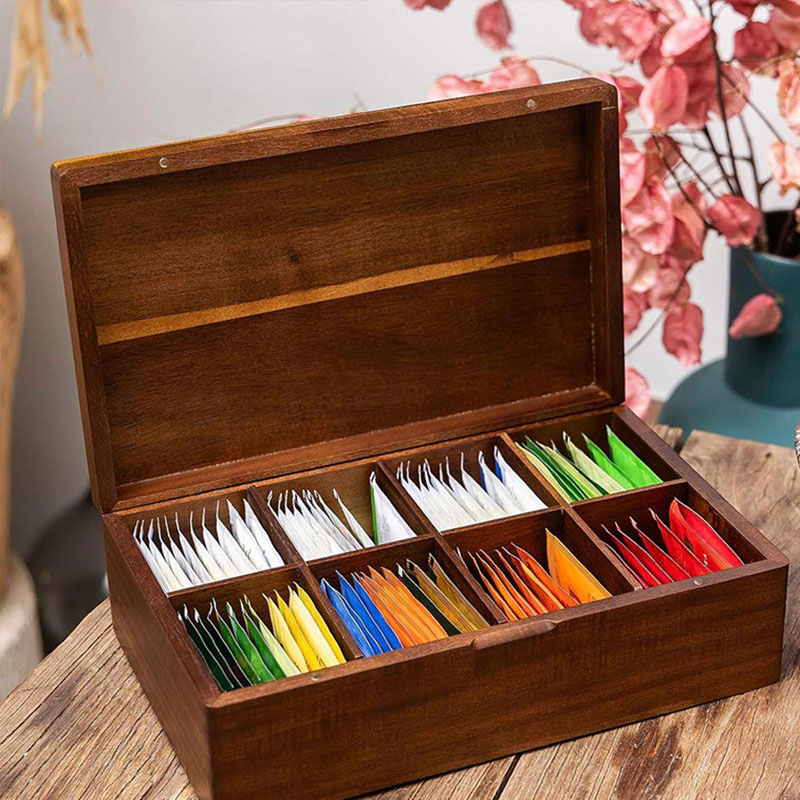
Bamboo and acacia are the two most popular kitchen-grade woods in our catalog. Both are dense. Both are food-safe. Both look beautiful. Both work well for tea boxes, cutlery organizers, spice racks, bread bins, charcuterie sets, and any other kitchen product where the wood is part of the visible design.
And yet they read as completely different products to the end customer. The same tea box in bamboo versus acacia ends up appealing to different shoppers, sitting at different price points, and competing in different retail channels. Picking the wrong one for your brand position is one of the most common mistakes we see in this category.
Here is how to make the right choice — based on the actual physical and commercial differences, not just material specs.
Side-by-side at a glance
| Property | Bamboo | Acacia |
|---|---|---|
| Density | ~700 kg/m³ | ~780 kg/m³ |
| Janka hardness | ~1380 | ~2300 |
| Color | Pale gold or carbonized caramel | Honey to chocolate, swirling |
| Grain | Horizontal striped | Dramatic swirling |
| Antibacterial | Yes (natural) | Mild (sealed surfaces) |
| Water resistance | Good (sealed) | Excellent (natural) |
| Sustainability | Excellent (5-7 yr regrowth) | Good (fast-growing tropical) |
| Cost index (vs paulownia=100) | 120 | 160 |
| Best price tier | $10-50 retail | $30-150 retail |
Bamboo — the eco choice
Bamboo is technically a grass, not a tree. It regrows in 5-7 years versus 30-60 years for hardwood. That single fact is why bamboo dominates the eco-positioned kitchen product market — it is the most genuinely renewable structural material we work with, and it is the only material we offer that customers immediately recognize as "the sustainable choice."
Beyond sustainability, bamboo has three properties that matter for kitchen use: it is naturally antibacterial (technically anti-microbial — bamboo contains a substance called "bamboo kun" that inhibits bacterial growth), it is harder than red oak (Janka 1380), and it takes a food-safe finish well.
Visually, bamboo has a distinctive horizontal striped grain that comes from how it is laminated — strips of bamboo glued together in alternating directions. Some buyers love this look (Muji-style minimalism, Japanese-influenced design, modern Scandinavian). Others find it too uniform or too obviously "bamboo-looking" and prefer the more wood-like grain of acacia.
Bamboo comes in two finishes: natural (pale gold) and carbonized (warm caramel from heat treatment). Carbonized is slightly softer than natural but visually warmer.
Acacia — the premium look
Acacia is a tropical hardwood with dramatic grain swirls and significant color variation between honey-blonde heartwood and chocolate-brown streaks. Every acacia board looks different. Every acacia box has its own grain pattern. Some buyers love this (premium uniqueness); some prefer bamboo's consistency.
Mechanically, acacia is harder than bamboo (Janka 2300 versus 1380), denser, and more naturally water-resistant. It does not need sealing as aggressively as bamboo to be kitchen-safe. It also takes oil and wax finishes beautifully — an oiled acacia surface develops a soft glow that bamboo never quite achieves.
The trade-offs: acacia is roughly 30-40% more expensive than bamboo at our typical volumes, the grain variation makes color matching across a multi-piece set harder, and acacia has no equivalent of bamboo's "obviously sustainable" market positioning.
A practical example — the same tea box, two materials
Take an 8-compartment tea bag organizer. Same dimensions, same internal layout, same hinged lid with magnetic closure.
In bamboo
Lands at $7-9 unit cost from us, retails at $22-32. Sells well at Target, on Amazon, in eco-positioned retailers like Whole Foods. Customers buy it because it is "the bamboo one" — they trust bamboo for kitchen products. Reviews emphasize sustainability and value.
In acacia
Lands at $11-14 unit cost from us, retails at $48-72. Sells in Williams-Sonoma, Crate & Barrel, premium specialty kitchen retailers. Customers buy it because it looks beautiful — they want a tea box that doubles as a kitchen object. Reviews emphasize craftsmanship and grain pattern.
Same box, same factory, double the retail price. The wood does the positioning work.
Care and longevity
Bamboo
With normal kitchen use and an annual re-oil with food-safe mineral oil, bamboo lasts 8-12 years before showing meaningful wear. The horizontal-striped grain will lighten subtly over time but does not significantly change.
Acacia
With the same care regime, acacia easily lasts 15-20 years. The grain pattern actually deepens with age — the chocolate streaks darken slightly and the surface develops a hand-rubbed patina. Acacia ages into something more beautiful than it started.
For products positioned as "buy it once" — premium cutlery boxes, charcuterie sets, family heirloom pieces — acacia's longevity is a meaningful differentiator. For products positioned for replacement-cycle retail, bamboo's lower cost wins.
Sustainability — the honest comparison
Bamboo wins this category clearly but not absolutely. Five-to-seven-year regrowth versus tree harvest cycles is the obvious advantage. Plantation-grown, with extensive root systems that improve soil and prevent erosion, also strong points.
But bamboo manufacturing is not perfectly green. Most engineered bamboo boards use formaldehyde-based adhesives in the lamination process. Reputable suppliers use low-emission E1 or E0 grade adhesives that meet EU and California standards. Cheap suppliers use higher-emission adhesives that fail those standards. Always ask for emission test reports if you are positioning the product as eco-premium.
Acacia, particularly tropical-grown acacia from Vietnam and Indonesia, is now widely plantation-grown rather than wild-harvested. Look for FSC certification on acacia (we offer it on request). Without FSC, the supply chain history of acacia is harder to verify than bamboo.
The decision framework
When buyers ask us "bamboo or acacia for this kitchen product?", we ask three questions back:
- What is the retail price target? Under $40 → bamboo. $40-100 → could go either way. Above $100 → acacia.
- What is the brand voice? Eco / sustainable / minimalist → bamboo. Premium / craftsmanship / heritage → acacia.
- What channel is selling? Mass / Amazon / Whole Foods → bamboo. Specialty / department store / direct premium → acacia.
How each performs in real kitchen conditions
Specifications and price tiers are useful, but kitchen products live or die based on how they hold up to actual kitchen use. Here is what we have learned from buyers who came back with photos of their products after 1-2 years in customer hands.
Daily moisture exposure
Both species handle moisture well when properly sealed. Bamboo, properly oiled, can be hand-washed indefinitely without warping (never dishwasher — neither species survives that). Acacia is naturally more water-resistant due to its higher natural oil content; an unfinished acacia surface will repel water more readily than unfinished bamboo.
For products that will be hand-washed frequently (cutting boards, tea boxes), both work. For products that will get splashed but rarely fully wet (spice racks, bread bins), acacia's grain pattern hides minor water marks better than bamboo's uniform striped grain.
Knife and impact damage
Acacia's 2300 Janka hardness means it dents less easily than bamboo (1380). For cutting board applications specifically, this matters — bamboo cutting boards show knife marks more visibly within the first year of use; acacia stays cleaner-looking longer.
For non-cutting kitchen products (caddies, spice racks, tea boxes), the hardness difference is largely invisible to the customer.
Heat exposure
Both are fine for ambient kitchen heat. Neither should be used near direct stovetop heat or in oven applications — both will scorch and discolor at temperatures above 80°C sustained.
Care instructions worth printing on the box
For both species, customers who follow simple care get years more product life. We strongly recommend including a small care card in the packaging for any kitchen product. The card should cover:
- Hand-wash only with mild dish soap and warm water
- Towel dry immediately, do not air-dry on countertop
- Re-oil with food-safe mineral oil every 3-6 months for cutting/serving products
- Do not soak, do not put in dishwasher, do not microwave
- Avoid prolonged direct sunlight (causes color fade in both species)
- Sand lightly with 320-grit and re-oil if surface develops rough patches over time
A printed care card adds about $0.04 per box and meaningfully reduces customer returns and complaints. We can print and include them with any kitchen-product order.
Frequently asked questions
Can I claim "antibacterial" on bamboo products?
Bamboo does have natural antimicrobial properties (the substance is called "bamboo kun") that inhibit some bacterial growth on bare bamboo surfaces. However, marketing claims about antibacterial properties are heavily regulated in most markets — in the EU and US, you generally cannot make specific health claims without supporting test data. Most buyers describe bamboo as "naturally hygienic" or "naturally resistant to bacterial growth" rather than making explicit antibacterial claims. Consult your market's regulations.
Which species takes laser engraving better?
Bamboo has higher contrast under laser due to its pale base color — engraving shows up as crisp dark marks. Acacia's darker color reduces laser contrast; engraving on acacia looks more subtle, sometimes too subtle. For brands that want highly visible logo placement, bamboo is the better laser substrate.
Can I get FSC certification on both?
Yes, both are available with FSC chain of custody. Acacia FSC supply is somewhat tighter than bamboo (which is widely plantation-grown). For high-volume FSC acacia orders, expect a 1-2 week longer lead time and a slight cost premium (typically 5-8%) above non-FSC acacia.
Is one species better for export to specific markets?
Bamboo has stronger market acceptance in Europe (especially Germany, Netherlands, Scandinavia) due to its sustainability story. Acacia has stronger traction in North American premium kitchen retailers (Crate & Barrel, Williams-Sonoma) due to its visual appeal. Both work well in Japan and Korea — Japanese customers especially appreciate bamboo's minimalist aesthetic.
Can I mix bamboo and acacia in the same product?
Yes, and it can produce striking results — bamboo body with acacia handles, acacia base with bamboo dividers. Mixing materials adds visual interest and lets you balance cost. The trade-off is that the two species expand and contract slightly differently with humidity, so mixed-species joinery needs designed-in tolerance to avoid stress over years.
Bamboo and acacia are not interchangeable — they look different, they age differently, they sell at different price points and they appeal to different customers. Choose the one that fits where the product is going to live, not just where it is going to be made.