How to choose the right wood for gift packaging
Paulownia, pine, beech, bamboo, acacia, walnut — a buyer's comparison for cost, weight, finish, feel and the freight bill nobody warned you about.
Wood selection is the single biggest decision in any gift packaging project. It drives unit cost, freight cost, finish quality, perceived premium-ness, end-of-life recyclability and how the box reads in the customer's hand. Sometimes it matters more than the design itself.
And yet most buyers spend ten minutes on it. They pick "pine" or "paulownia" because that is what they saw on the last project, or because that is what the factory quoted. Six months and one container later they discover the box was twice as heavy as it needed to be, and the freight ate their margin.
Here is how we think about each species when a buyer asks us "which wood should I use?" — written for the buyer side of the conversation, with real cost framing.
The hidden cost: freight, not material
Most buyers focus on material cost per board-foot. That is the wrong number. For most gift packaging projects shipped from China, the freight component dominates — especially for bulky retail boxes shipped LCL or via Amazon FBA.
A 25 cm cube made from oak weighs roughly 4 kg. The same cube made from paulownia weighs about 1.6 kg. On a 20-foot container holding 6,000 of those boxes, you are talking about a 14,400 kg difference in chargeable weight. That is real money.
Material cost matters. Freight cost matters more. Pick wood for both.
Paulownia — the volume default
Paulownia is the lightest commercial timber on Earth — density around 280 kg/m³, which is roughly half of pine and a third of oak. For high-volume gift packaging it wins on freight cost alone, before you consider any other variable.
It is also dimensionally the most stable wood we work with. It will not warp or crack across humidity changes, which is critical for boxes shipped to dry climates (Phoenix, Australia interior) or humid ones (Florida, Southeast Asia). And its straight even grain takes laser engraving cleanly with high contrast.
The downside: paulownia is soft. Janka hardness around 300 — easy to dent if dropped or stacked aggressively. So it is not what you want for a tool box or a serving caddy that is going to live a hard life. But for a gift box that gets opened once and then displayed on a shelf, paulownia is almost always the right call.
Best for: large gift boxes, wine boxes, subscription packaging, FBA-bound products, anything where freight matters.
Pine — affordable and rustic
Scots pine and radiata pine give you classic warm grain at the lowest price-per-board-foot of any softwood we stock. We work with two grades: knot-free pine for clean retail packaging, and rustic knotty pine for crate-style wine and farmhouse-themed gifting.
Pine takes wood-burning beautifully — branded wine boxes with burned-in vintage and producer name are pine's signature application. It also stains evenly, paints cleanly, and oils to a deep amber over time.
It is heavier than paulownia (~510 kg/m³) but less dimensionally stable than acacia or walnut. We dry it carefully and recommend it for products that are not crossing extreme climate zones. For a wine box going from China to a UK distributor, pine is fine; for a wine box going from China to a Phoenix retailer in July, we would push you toward paulownia or kiln-dried oak.
Best for: wine boxes, garden crates, rustic gifting, mid-tier corporate gifts where budget matters more than premium feel.
Bamboo — the sustainability story
Technically bamboo is a grass, not a tree. It regrows in 5–7 years versus 30–60 years for hardwood, which makes it the most genuinely renewable structural material on the planet. For brands with an explicit eco message, bamboo is the only honest choice.
Bamboo also happens to be naturally antibacterial — making it the default choice for kitchen products, bath accessories and anything that touches food or skin. It is harder than red oak (Janka ~1380), more water-resistant than most hardwoods, and finishes to a beautiful warm-gold or carbonized-caramel surface.
The trade-off: bamboo grain is striped rather than swirling. If you want a "natural wood" look, bamboo reads as obviously bamboo, not as wood. Some brands love that look (Muji-style minimalism, Japanese-influenced design). Others find it too modern and want the swirling grain of acacia or oak.
Best for: tea boxes, kitchen storage, bath accessories, eco-positioned subscription boxes, anything with an explicit sustainability message.
Acacia — premium hardwood at a sensible price
Acacia is the under-appreciated hero of our catalog. Janka hardness above 2300 (harder than oak), dramatic swirling grain with chocolate-brown streaks running through warm honey heartwood, and pricing that lands well below walnut while looking nearly as premium.
It is naturally water-resistant — important for kitchen and bath applications — and finishes beautifully with just oil and wax, no lacquer needed. The grain variation means every box looks subtly different, which buyers either love (uniqueness, hand-craftedness) or dislike (consistency concerns for retail).
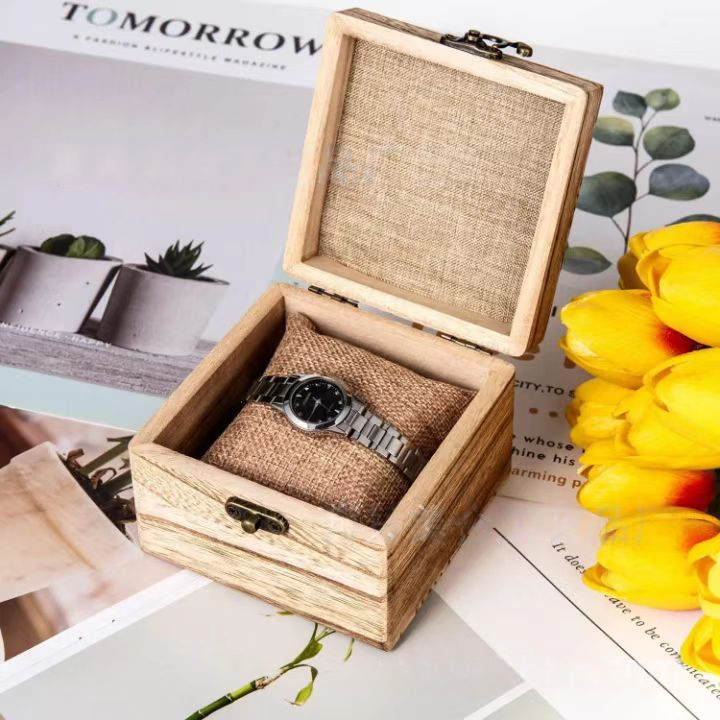
Best for: premium gift boxes, kitchenware, charcuterie sets, mid-luxury watch boxes, anything where the grain itself is part of the appeal.
Walnut — the luxury default
American black walnut is the most coveted hardwood in the gift industry. Naturally deep chocolate color (no staining required), silky smooth surface that polishes to glass, and fine straight grain that takes engraving and inlay work beautifully.
It is also expensive — typically 3-4× the cost of paulownia and 2× the cost of acacia. For most gift packaging that is overkill. For watch boxes, fine jewelry, limited-edition spirit gifting, and executive gifting where the box itself needs to feel like part of the gift, walnut is the only option that does the job.
Walnut also ages beautifully — the chocolate tone deepens and develops a warmer red-brown patina over 5-10 years. Customers notice this. It is one of the few materials that genuinely improves with use.
Best for: heirloom watch boxes, fine jewelry presentation, limited-edition spirit gifting, executive gifting, anything positioned at $80+ retail.
Side-by-side comparison
For a 20×15×8 cm gift box ordered at 1,000 units, here is how the species roughly compare. Prices are indexed (paulownia = 100) so the relative differences are clear.
| Species | Density | Hardness | Cost Index | Best At |
|---|---|---|---|---|
| Paulownia | 280 kg/m³ | Janka 300 | 100 | Volume / freight |
| Pine | 510 kg/m³ | Janka 380 | 95 | Rustic / affordable |
| Bamboo | 700 kg/m³ | Janka 1380 | 120 | Eco / kitchen |
| Acacia | 780 kg/m³ | Janka 2300 | 160 | Premium look, sensible price |
| Walnut | 640 kg/m³ | Janka 1010 | 320 | Luxury / heirloom |
A practical decision framework
When buyers ask us "which wood should I use?", we usually ask three questions back:
- What is the retail price point? Under $30 → paulownia or pine. $30-80 → bamboo or acacia. $80+ → walnut or premium acacia.
- How is it shipping? FBA / LCL / heavy international freight → paulownia or bamboo for weight. Local distribution → less critical.
- What is the brand voice? Eco-forward → bamboo. Rustic → pine. Modern minimalist → bamboo or paulownia. Premium / heirloom → walnut or acacia.
The right answer almost always falls out from those three questions. The wrong answer is "whatever is cheapest" — because the cheapest wood for a $3 box becomes the most expensive when freight is doubled and 12% of the units arrive warped.
Three real buying scenarios
Theory is easy; the choices get harder once you have a real product, a real budget and a real timeline. Here are three scenarios from buyers we worked with last year, with the wood we actually recommended and why.
Scenario 1 — A French candle brand launching premium gift packaging
Brief: 8,000 units, lift-off lid box for a $65 retail candle line, FBA Europe distribution, premium minimalist brand voice. Budget: $4 per box landed in Amazon's warehouse.
Their original spec called for European beech — a beautiful pale hardwood that they had seen on a competitor's product. We pushed back: beech at this size weighs roughly 1.4 kg per box, which would have pushed their FBA dimensional weight into the next fee tier and added about $0.85 per unit in fulfillment fees alone.
Our recommendation: paulownia with white-stain finish and debossed brand mark. Same visual lightness, less than half the actual weight, identical premium feel after staining. Final unit cost landed at $3.65 — under budget by 9%, with the FBA fee savings funding the white-stain finish that beech would not have needed.
Scenario 2 — A US wine importer launching a single-bottle gift box
Brief: 5,000 units per quarter, single-bottle wine box with rope handle, distributed through small-batch wine retailers and restaurant suppliers. Budget: $5.50 per box landed.
They wanted oak. Oak would have looked great but would have come in at $7.20 per box — well over budget. We suggested knotty pine with wood-burned branding and a raw-finish (no lacquer, just oil) treatment.
The result was actually a better fit for the brand than the original oak spec. Knotty pine reads as "small producer" and "rustic" in a way that polished oak does not. Final unit cost: $4.80 — under budget, faster lead time (4 days saved by skipping the lacquer stage), and exactly the tone the brand was going for.
Scenario 3 — A Korean watch brand launching a 6-watch presentation case
Brief: 1,200 units per year, 6-watch presentation case, sold direct-to-consumer at $280 retail, premium positioning. Budget: $35 per box landed.
No question about the wood — at this price point and this brand voice, the answer was American black walnut with hand-rubbed oil finish and concealed European hinges. Anything less would have undermined the watch positioning. Hand-finished oil revealed the grain rather than masking it under lacquer.
Final unit cost: $32.40 — under budget while delivering a box that consistently appears in the brand's customer unboxing photos on Instagram. The walnut box has become part of the brand identity, which is exactly what the buyer was hoping for.
Common wood-selection mistakes we see
- Picking the cheapest wood for everything — works for $5 boxes, ruins $50 boxes by undermining premium positioning.
- Not asking about moisture content — leads to warping and cracking after shipment to climates very different from the factory floor.
- Specifying wood that does not match the brand voice — bamboo for traditional luxury, walnut for casual wellness, pine for tech accessories. The wood needs to read right in the customer's hand.
- Forgetting freight in the math — a heavy wood that ships poorly costs more total than a lighter wood at higher per-board-foot price. Calculate landed cost, not material cost.
- Ordering volume before testing climate behavior — always test one sample for 30 days in the destination climate before committing to scale. Wood does what it does whether you tested for it or not.
- Confusing "exotic" with "premium" — bubinga, padauk, zebra wood look exotic but are difficult to certify, expensive to ship, and inconsistent in supply. Stick with the species buyers can actually source reliably.
Frequently asked wood questions
How do I match the wood across multiple production runs?
Same species and same supplier is the starting point — but natural wood will always vary slightly between batches, especially in heartwood color and grain pattern. For projects where consistency matters (large retail rollouts, multi-piece sets), specify "from a single forest lot" in your order; we can hold back inventory from one lot to ensure consistency. For smaller projects, accept that some variation is part of using real wood.
Should I worry about wood from China specifically?
Country of origin matters less than supplier traceability. Chinese-grown paulownia, bamboo and acacia are all high quality with established plantation supply chains. Walnut, oak and beech we typically import from North America or Europe to our finishing factory in Cao County. Ask your factory for source documentation on every species — that matters more than which country processed the wood.
Can you mix species in one box?
Yes, frequently. Walnut frame + paulownia base, bamboo body + acacia handles, that kind of thing. Mixed-species boxes can hit a price/look balance neither species alone would achieve. The catch is that different species expand and contract at different rates — for boxes shipping to extreme climate variations, mixed-species construction can cause joint stress. We design around this with floating-panel construction where appropriate.
Pick wood for the climate it will live in, the freight bill it will travel on, and the price point it will sell at. The factory can quote on anything you ask for — but the cost shows up everywhere downstream.