Designing wooden packaging for Amazon FBA
Dimensional weight, master carton sizing, FNSKU labels, packaging compliance — the small choices that save thousands per shipment over a 12-month sales cycle.
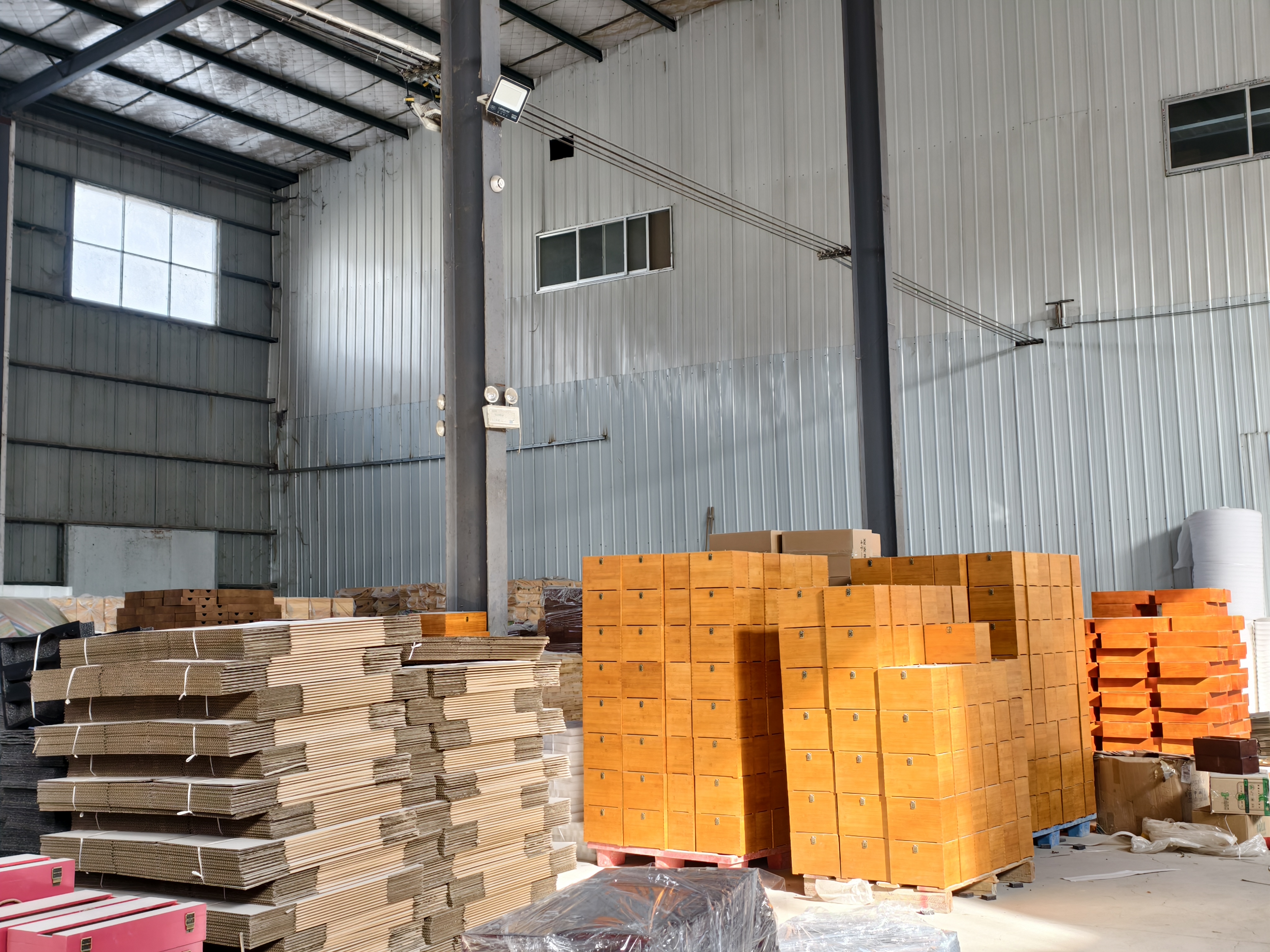
Selling wooden boxes through Amazon FBA is its own discipline. The product matters less than the packaging strategy that wraps around it. Two sellers can offer the same wooden box at the same retail price and end up with completely different unit economics — one profitable, one losing money on every sale — because of decisions they made about packaging.
This article is what we have learned from making FBA-bound wooden products for sellers since 2018, including the small choices that quietly compound into thousands of dollars saved (or lost) per shipment.
The dimensional weight trap
Amazon charges fulfillment fees by dimensional weight, not actual weight. Dimensional weight is calculated as length × width × height ÷ 139 (in inches and pounds), so a bulky lightweight product can incur fees as if it were many times its actual weight.
For wooden products this matters more than for almost any other category, because wood density varies dramatically by species. A 30 cm cube of oak weighs roughly 4 kg. The same cube in paulownia weighs about 1.6 kg. Both ship for the same FBA fee — but if you specified oak when paulownia would have worked, you are paying twice the freight cost into Amazon's warehouse for nothing.
For high-volume products where the wood is not the visible feature (most gift packaging — the customer sees the lid surface, not the cross-section), choosing the lighter species can save $0.40-1.20 per unit in inbound freight. Across 10,000 units that is $4,000-12,000 of pure margin gained.
Master carton sizing — Amazon's ever-changing rules
Amazon's FBA carton size and weight limits update periodically (most recently in 2024 and again in early 2026). Cartons that fall within the standard size limit are dramatically cheaper to receive than cartons that exceed it.
Current standard carton limits at the time of writing:
We design master cartons to land just inside the largest standard size — usually 25-32 units per master carton for typical wooden gift boxes. This balances the trade-off between Amazon's carton fee structure and your inbound freight cost per unit.
Slightly oversized cartons trigger oversized handling fees that add about $1.30-2.80 per carton. On a 200-carton shipment that is $260-560 of extra fees. We catch this routinely on first-time orders where the buyer specified the master carton size without realizing the FBA implications.
FNSKU labels — apply at factory, not at warehouse
Every FBA unit needs an FNSKU barcode label visible to Amazon's receiving scanners. You can either:
- Apply labels yourself in your warehouse before shipping to Amazon
- Have the factory apply labels to each unit before shipment
- Pay Amazon to apply labels at intake ($0.30 per unit at the time of writing)
Option 3 is almost always the wrong answer. Across 5,000 units, that is $1,500 of avoidable fees plus 1-2 weeks of additional intake delay. We pre-apply your FNSKU labels at our factory, validate placement against the latest Amazon spec (label visible without unboxing, no stickers covering the original barcode, no curved surface placement), and provide photographic proof for your records.
This service costs us about $0.05-0.08 per unit and is included in the FBA-prep upcharge we quote.
Polybag vs. retail-ready boxes
Every FBA unit needs to be either bagged with a suffocation warning or sealed in a retail-ready outer carton. Three approaches:
Polybag with suffocation warning
Cheapest option (~$0.10 per unit). Customer unboxing experience is the box itself with a clear plastic bag around it. Acceptable for utilitarian products; not great for premium gifting.
Branded outer carton (retail-ready)
Standard for premium products. The wooden box ships inside a printed paper carton designed to be the customer-facing packaging. Adds $0.80-2.50 per unit but transforms the unboxing experience and is essential for any product positioned at $40+ retail.
Branded sleeve over the wooden box
Hybrid approach. The wooden box is wrapped in a printed paper sleeve (cheaper than a full carton) plus a polybag for FBA suffocation compliance. Adds $0.40-0.80 per unit. Works well for mid-tier products.
Pre-shipment inspection — the cost vs. risk equation
We strongly recommend a third-party inspection (SGS, BV, AsiaInspection, Asia Quality Focus) for every FBA shipment. The reason is brutal economics: returns from Amazon are expensive — anywhere between 5% and 15% of the shipment value depending on category, plus the brand damage from negative reviews.
A typical pre-shipment inspection costs $250-380 and takes one working day. The inspector visits our factory, samples to AQL 2.5 standards (about 32 units sampled from a 1,000-unit lot), inspects against your spec sheet, and produces a report with photographs.
For a $5,000 shipment, the inspection is 5-7% of the shipment value. For a $50,000 shipment, it is 0.5-0.7%. In both cases the math favors inspection — a single defect-related return event for an entire FBA shipment can cost more than 10× the inspection fee in fees, freight, brand damage and reduced future Buy Box performance.
Documentation — what Amazon needs vs. what customs needs
FBA shipments need two parallel documentation tracks: customs documentation for the import, and FBA shipment documentation for Amazon receiving.
Customs documentation (we handle)
- Commercial invoice with HS codes
- Packing list with carton-by-carton breakdown
- Phytosanitary certificate (mandatory for solid wood)
- Certificate of origin
- ISF (Importer Security Filing) data 24 hours before vessel loading for US-bound containers
FBA documentation (you handle, we provide data)
- Shipment plan in Seller Central matching exact carton counts and weights
- Carton-level FBA labels printed and applied
- Pallet-level pallet labels for LTL shipments
- BOL (bill of lading) for the freight forwarder
Mismatches between these documents are the #1 cause of FBA receiving delays. We send you a complete documentation packet with carton dimensions and weights so your shipment plan in Seller Central matches what actually arrives at Amazon. Mismatches trigger reconciliation that can delay receiving by 2-3 weeks.
A 12-month example
A buyer launching a wooden tea box on FBA at 1,000 units/month for 12 months. Two scenarios:
Scenario A: Default decisions
Oak (heavier, fine-grained but bulky shipping weight). Carton sized for buyer's warehouse convenience. Labels applied by Amazon at intake. Polybag packaging. No pre-shipment inspection.
Scenario B: FBA-optimized
Bamboo (lighter, eco-positioned, lower freight). Master carton sized for FBA standard tier. Labels pre-applied at factory. Branded retail-ready outer carton. Pre-shipment inspection on every shipment.
Across 12 months and 12,000 units, Scenario B saves roughly $14,000-19,000 in fees alone (lower dimensional weight, no Amazon labeling fees, no oversize carton handling fees). Add to that lower return rates from inspection, higher review scores from premium unboxing, and the gap widens further.
The actual product is the same. The packaging strategy is what produces the financial outcome.
Q4 inventory planning — the trap most sellers fall into
Wooden box categories are heavily Q4-seasonal. Gift boxes, watch boxes and presentation boxes can do 60-70% of their annual volume in October-December. The trap is sellers ordering Q4 inventory in August and finding their goods stuck in the receiving queue at peak.
Amazon's warehouses get progressively more congested from mid-September through mid-December. Receiving times that are 3-5 days in summer can stretch to 3-4 weeks in late October. Inventory that misses Black Friday because it is sitting in receiving represents lost revenue you cannot recover.
Our recommended Q4 timeline:
- June-July: Place Q4 production orders. Allow 25-35 days production for OEM, 18-28 for ODM.
- August: Production complete, begin shipping. Aim for inventory landing in your warehouse by end of August.
- Early September: Ship first FBA load. This catches Amazon's lighter receiving period.
- Late September: Ship second FBA replenishment. Both loads should be checked into FBA before October 1.
- October-December: Replenish only via small air freight if needed. Do not rely on sea freight in Q4.
For wooden products specifically, sea freight from China to US/EU has been running 22-35 days in 2025-2026. Add 7-14 days for FBA receiving. That is 30-50 days from departure to sellable. Plan accordingly.
Returns management — the silent margin killer
Wooden box return rates on Amazon vary dramatically by product type:
Most returns are not defects — they are buyer dissatisfaction. The product looked larger in photos than in person. The wood color was different from the listing image. The closure mechanism was unfamiliar. The packaging was less premium than expected.
Three things reduce return rates substantially:
1. Show actual unboxing in your listing photos
Customer photos of opening the box, removing tissue, holding the box at scale to a coffee mug or hand. This sets accurate expectations. Stock photos showing the box on a white background create a "this looks bigger online than in person" return reason.
2. Specify dimensions in the title and bullets
Title: "Walnut Watch Box · 6 Watches · 12.5 × 9 × 5.5 inches." Customers who buy after reading the dimensions are not surprised by the size on arrival. Customers who buy without seeing dimensions return at 2-3× the rate.
3. Include a printed care card
A small card explaining how to maintain the wood reduces "the surface developed marks within a month" complaints. Costs $0.04 per box; reduces return rate by an estimated 1-2 percentage points based on data buyers have shared with us.
Frequently asked FBA questions
Should I use Amazon's prep service for wooden boxes?
No, almost never. Amazon's prep service charges $0.30+ per unit for labeling, polybagging, or other prep — costs that are pure margin loss when we can do the same prep at the factory for $0.05-0.08 per unit. The only exception is if you are sending direct from a different supplier and physically cannot do prep yourself; otherwise, factory prep is always cheaper.
How do I handle different SKU variations?
Each variation (color, wood species, size) needs its own FNSKU and its own ASIN. We pre-apply the correct FNSKU on each unit at the factory, sorted by variation. The packing list shows quantities per FNSKU per master carton, which matches what Amazon expects to receive. Mistakes here are the #2 cause of receiving delays after dimensional mismatches.
Can you ship LCL or do I need a full container?
Both, depending on volume. LCL (Less than Container Load) makes sense for orders under about 12-15 cubic meters. Full container (FCL) becomes more economical above 18 m³. Between 15-18 m³, run the math both ways. We can quote both options on every order and let you decide based on your inventory turn.
What about Amazon Brand Registry and design protection?
Brand Registry requires a registered trademark in the country where you sell. For wooden box brands, we strongly recommend trademarking your brand name and any distinctive logo before launching on Amazon. Without Brand Registry, your listings are vulnerable to hijacking by counterfeiters — which is depressingly common in the wooden box category.
Selling wooden boxes on Amazon is not a product business. It is a freight, fees and reviews business — and the packaging decisions are where you win or lose.